
Utilizing MCP Servers for Accurate Copper Price Projections

Note to reader/how to read this article: Bracketed [CONFIRM] items require verification from the person configuring the server before publication.
An AI agent should not have to guess what “copper prices” means. A properly designed copper MCP server resolves four things in a single structured request, each returned as a separate typed field rather than blended into one opaque answer:
- Exchange benchmark: the selected reference and its contract timing
- Regional premium: any applicable premium series, or an explicit unavailable result
- History: the dated series behind the current value
- Forecast: available forecast output, labeled as forecast
That distinction carries cost consequences. A U.S. sourcing workflow may reference COMEX copper futures in dollars per pound, while a global contract may reference LME three-month copper in dollars per metric ton. Those are related market references quoted in different units, and neither should be silently substituted for the other.
MetalMiner’s data environment supplies the building blocks that keep the workflow explicit:
- Catalogue discovery
- Current and historical pricing
- Unit and currency conversion
- Technical levels
- Comparative analysis
- Forecast-capability discovery
The design challenge is not connecting a language model to a price feed. It is preserving the market definition throughout the response.
What Should a Single “Copper Prices” Request Return?
Return a typed market-context object, not a naked number. It should identify the requested benchmark and its unit before presenting a value, and keep optional data separate from the exchange quote. That separation stops an agent from treating an unavailable premium as zero or from presenting a forecast as a current market price.
A practical get_copper_context operation should return four independent objects, plus a metadata object carrying:
- Selected benchmark and contract timing
- Currency and unit
- Timestamp and source
- Data-status flags
Here is the json:
{
  "commodity": "copper",
  "benchmark": "COMEX_3M",
  "currency": "USD",
  "unit": "lb",
  "as_of": "[CONFIRM: ISO-8601 timestamp]",
  "exchange_quote": {
    "benchmark": "COMEX_3M",
    "contract_timing": "three_month",
    "value": "[CONFIRM: numeric field name]",
    "currency": "USD",
    "unit": "lb",
    "observation_date": "[CONFIRM: date field]"
  },
  "regional_premiums": [
    {
      "region": "[CONFIRM: region identifier]",
      "basis": "[CONFIRM: premium basis]",
      "value": "[CONFIRM: numeric field name]",
      "currency": "[CONFIRM: currency]",
      "unit": "[CONFIRM: unit]",
      "status": "available"
    }
  ],
  "history": {
    "frequency": "daily",
    "start_date": "2024-01-01",
    "end_date": "2024-12-31",
    "series": [
      {
        "date": "2024-01-02",
        "value": "[CONFIRM: numeric field name]"
      }
    ]
  },
  "forecast": {
    "status": "[CONFIRM: available | unavailable | not_entitled]",
    "presentation": "[CONFIRM: forecast composition field]",
    "data": []
  },
  "metadata": {
    "source": "MetalMiner",
    "benchmark_explicit": true,
    "unit_conversion_applied": false
  }
}
Implementation requirement. Add the following before treating this schema as a production contract:
- Final field names
- Enum values
- Entitlement behavior
- Timestamp semantics
Why Is the Benchmark Parameter Not Optional?
The most common copper-data error happens when an application asks for “copper” without naming an exchange and the system quietly picks one. A production server should reject that ambiguity rather than resolve it.
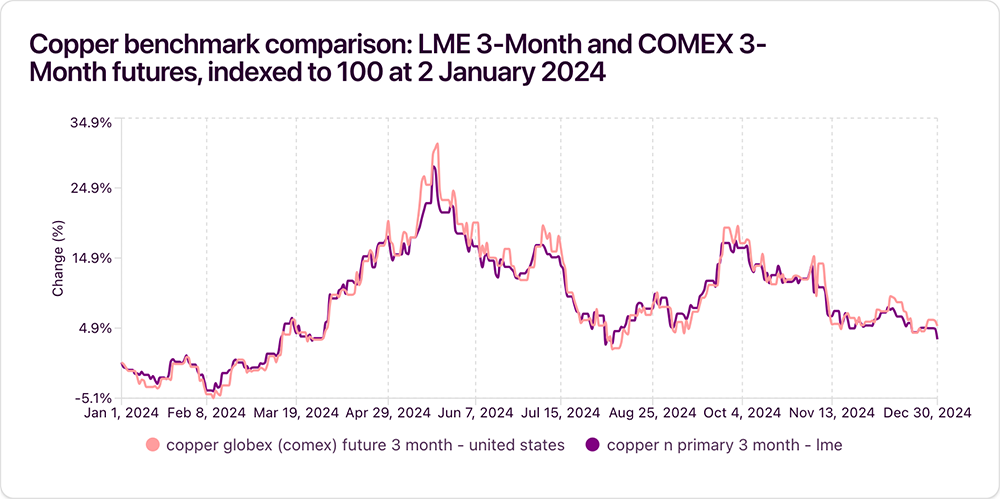
MetalMiner tracks an LME copper three-month series in U.S. dollars per metric ton and a COMEX copper three-month futures series in U.S. dollars per pound. The LME data catalog also distinguishes cash from three-month timing. Neither series can be compared, summed, or substituted for the other without first identifying the benchmark and applying a transparent unit conversion.
| Decision point | LME three-month copper | COMEX three-month copper |
| Market reference | LME copper | COMEX copper futures |
| Native quotation basis in MetalMiner data | USD per metric ton | USD per pound |
| Timing distinction | Separate cash and three-month series are available | Separate spot and three-month series are available |
| Safe agent behavior | Return only when benchmark=LME_3M | Return only when benchmark=COMEX_3M |
| Unsafe agent behavior | Treat as a COMEX equivalent | Treat as an LME equivalent |
A benchmark is also not a regional premium. The Midwest Premium is an aluminum premium reference, not a copper exchange benchmark. In a multi-metal workflow, the server should label it as an aluminum regional-premium series and never return it against a copper request because the application asked for “a metal premium.”
What Should the Server Return When the Benchmark Is Missing?
Not a number. Return a structured ambiguity response that names the valid choices and states what the agent must supply next. That keeps the error visible inside a sourcing workflow, an analyst chat, or an autonomous agent loop.
Here is the json:
{
  "status": "needs_benchmark",
  "error": {
    "code": "BENCHMARK_REQUIRED",
    "message": "Copper requires an explicit benchmark. Choose an exchange and contract timing before requesting price data."
  },
  "candidates": [
    {
      "benchmark": "LME_3M",
      "display_name": "LME copper three-month",
      "currency": "USD",
      "unit": "metric_ton"
    },
    {
      "benchmark": "COMEX_3M",
      "display_name": "COMEX copper three-month futures",
      "currency": "USD",
      "unit": "lb"
    }
  ],
  "required_parameter": "benchmark"
}
Which MetalMiner Data Sits Behind a Copper Request?
MetalMiner’s commodity catalog holds 2,582 individual commodity and metal series across non-ferrous metals, steel, stainless surcharges, minor metals, rare earth metals, ferroalloys, scrap, energy, and minerals. Historical coverage extends as far back as January 1, 1947, for the earliest available series, though coverage remains series-specific.
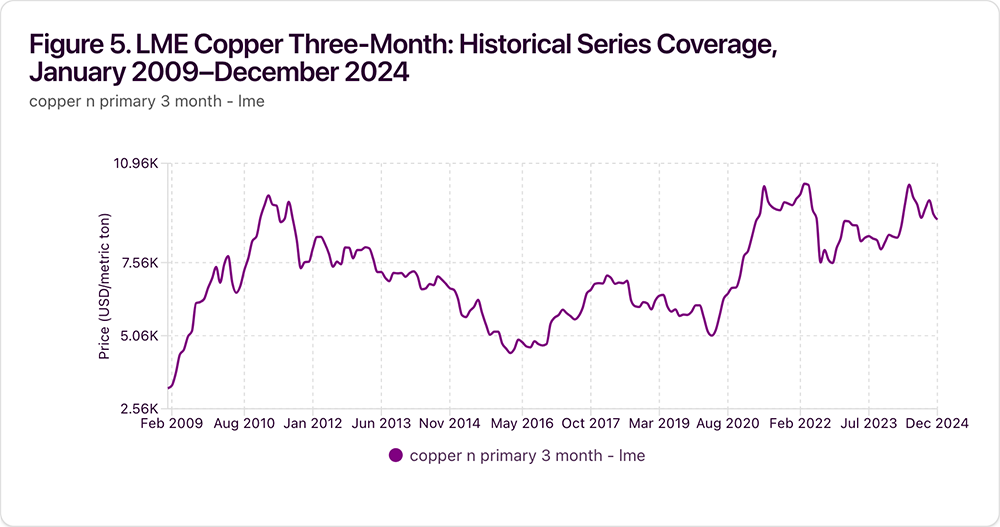
For copper, the currently cataloged LME three-month series begins in 2009, and the COMEX three-month futures series begins in 2019. Those dates describe the listed series, not a universal guarantee of copper price history. Discovery responses should therefore expose first_available_date, last_available_date, and series_status rather than promise a fixed look-back period.
| Capability to expose | Core request parameters | What the agent should receive |
| Instrument discovery | commodity, benchmark, region, form, currency, unit | Exact series name, native unit, native currency, history availability, and forecast capability |
| Current exchange price | benchmark, contract_timing, currency, unit | Latest value, observation date, source basis, conversion status |
| Historical series | benchmark, start_date, end_date, frequency, currency, unit | Dated observations plus availability and trend metadata |
| Premium lookup | commodity, premium_region, timing, currency, unit | Premium series or an explicit unavailable result |
| Conversion | value, from_currency, to_currency, from_unit, to_unit, date | Converted value and conversion basis |
| Forecast discovery and retrieval | benchmark, forecast_horizon, currency, unit | Availability flags and, when entitled, a clearly labeled forecast object |
| Technical context | benchmark, analysis_date, lookback_window | Support and resistance levels, price position, and associated signals |
Missing coverage should stay visible. If a request asks for a copper premium in a region without an available series, return an empty regional_premiums array and an explanatory status object. Do not backfill it with an exchange price, an aluminum premium, or an inferred freight adjustment.
How Does One Contract Serve Several Metal Categories?
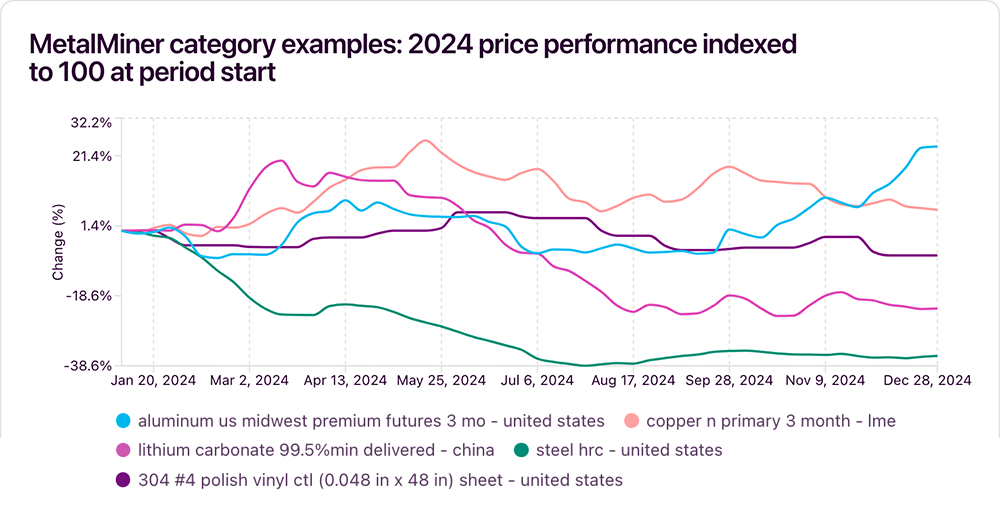
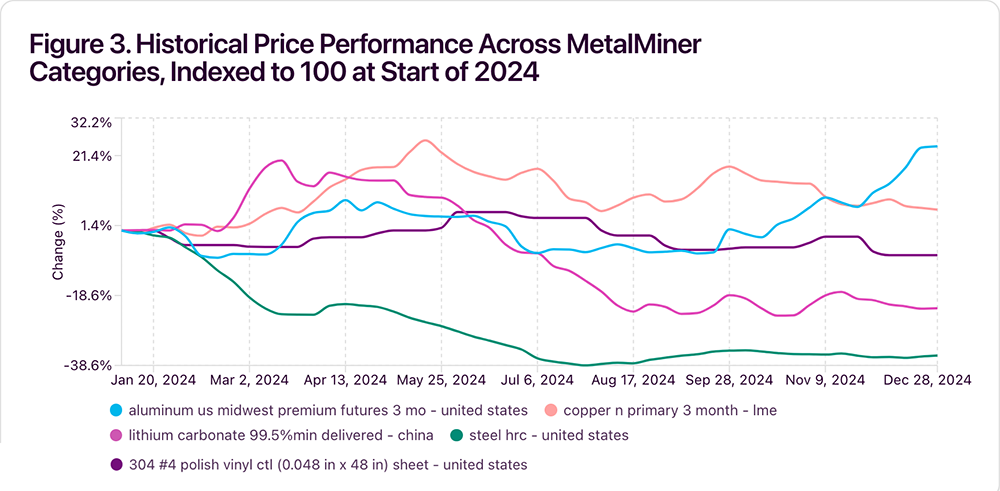
A copper server earns wider use when its field discipline extends across a category manager’s full spend. The same response structure can serve U.S. hot-rolled coil, 304 stainless sheet, aluminum and the Midwest Premium, and critical-mineral inputs such as lithium carbonate.

This is not a claim that every material carries identical history, forecast, premium, or technical-analysis coverage. The opposite holds. The agent should discover each series first, identify its market, form, origin, unit, currency, and available capabilities, and only then request price or analytical output.
A Chinese 304 cold-rolled coil price, a U.S. 304 sheet price, and a stainless surcharge are three different commercial references. The schema should preserve those distinctions.
How Should the MCP Client Be Configured?
The configuration block below is intentionally incomplete. It shows what an implementation page needs without specifying MetalMiner’s production endpoint, client support, transport, or authentication method.
Here is the json:
{
  "mcpServers": {
    "metalminer-copper": {
      "type": "[CONFIRM: transport type]",
      "url": "[CONFIRM: production MCP endpoint URL]",
      "headers": {
        "Authorization": "Bearer ${METALMINER_API_KEY}"
      }
    }
  }
}
The person walking through the setup must add the following before publication:
- [CONFIRM: supported MCP clients]: list only clients tested against the production server.
- [CONFIRM: transport]: state whether the server uses remote HTTP, Streamable HTTP, server-sent events, stdio, or another supported transport.
- [CONFIRM: authentication]: confirm bearer-token syntax, OAuth requirements, required headers, key rotation, and whether credentials may pass through environment variables.
- [CONFIRM: endpoint]: add the production endpoint and a separate sandbox endpoint, if one exists.
- [CONFIRM: permissions]: identify which tools require a specific subscription, forecast entitlement, or raw-data access.
- [CONFIRM: client-specific instructions]: provide separate configuration snippets where client formats differ.
How Should You Test Benchmark Selection First?
- Obtain credentials through Get API Key.
- Add the confirmed configuration block to a supported MCP client through Add to Claude or the relevant client setup flow.
- Call the catalog-discovery operation for copper and inspect the available LME and COMEX candidates.
- Request the LME three-month copper series explicitly, then request COMEX three-month copper explicitly. Verify that the native units differ.
- Request a historical range and confirm the response includes dates, values, units, and a series identifier or descriptive label.
- Test a copper request without benchmark. Confirm that the server returns needs_benchmark rather than a price.
- Request a different category, such as aluminum Midwest Premium, U.S. HRC, 304 stainless, or lithium carbonate, to confirm that the response retains material, form, market, unit, and currency metadata.
Frequently Asked Questions
Which copper exchange references are covered?
MetalMiner’s MCP catalog includes LME copper cash and three-month references and COMEX copper spot and three-month futures references. The production page should include a complete, version-controlled exchange-coverage table.
[CONFIRM: complete exchange, contract timing, and regional copper coverage list.]
Which premium regions are available?
Premium coverage is commodity- and region-specific. The server should return only available premium series and identify their basis, unit, currency, and timing. It should not infer a copper premium from another metal or region, and aluminum workflows should retain Midwest Premium as a separately identified proper-noun reference.
[CONFIRM: copper premium regions, premium methodology, and availability rules.]
How deep is the history?
The catalog’s earliest listed series begins in 1947, but the start date varies by commodity series. The cataloged LME copper three-month and COMEX copper three-month series begin in 2009 and 2019, respectively. Query-level availability should always prevail over a general statement.
How often do prices refresh, and what are the rate limits?
MetalMiner’s catalogue indicates updates through the latest trading day. A public implementation guide should state the production refresh cadence by series type, the timezone used for as_of timestamps, applicable quotas, burst limits, retry behavior, and rate-limit response headers.