
Base Metal Price Risk: How to Prepare for the Next Market Disruption

MetalMiner’s Market Signal handles supply chain disruptions with its modeling capabilities through structured what-if and policy-event scenarios. For each supported scenario shock, the run returns a baseline fan and a simulated fan, each with a median path and uncertainty range. The analytical value sits in the difference between those paths, not in a headline forecast.
A disruption model should answer a narrow but important question. If a defined event occurs, how could the price path change relative to the conditions assumed in the baseline?
It should not pretend to predict the next political decision, plant outage, or trade restriction. Nor can a price model guarantee that a buyer will secure physical material when an event occurs.

That distinction matters. Each of these teams has a related question, and the questions are not interchangeable:
- Financial planning teams need a defensible range for budget stress tests.
- Procurement leaders need to understand where an import-policy action may alter delivered cost even if global supply does not change.
- Supply chain leaders need to separate a price-risk scenario from a material-availability plan.
Supply chain disruptions: Which exposure should a disruption scenario model?
The first discipline is selection. A disruption may be globally important and still not be the right scenario for a company’s cost base.
The relevant question is which published price series most closely represents the material, region, form, and commercial exposure in the contract.
For aluminum, that can mean separating the London Metal Exchange (LME) aluminum price from the Midwest Premium. A disruption to primary metal supply and a U.S. trade-policy intervention may affect those benchmarks through different mechanisms. Treating both as one generic “aluminum price” erases the difference between global metal value, regional delivery economics, and policy-linked market structure.
The same rule applies across categories:
- A U.S. hot rolled coil (HRC) buyer does not carry the same risk profile as a buyer of Chinese HRC.
- A COMEX copper exposure differs from an LME copper exposure.
- Stainless steel requires attention to the actual purchased form, such as 304 2B sheet, rather than an assumption that nickel alone represents the bill-of-materials risk.
- Critical-mineral programs need equally precise definitions of grade, form, and delivery basis. Lithium carbonate and lithium hydroxide are not interchangeable exposures.
Step 1: Which metal price and risk exposures deserve a formal scenario?
Not every event needs a formal model run. Use the organization’s risk-monitoring process to prioritize exposures for deeper scenario review.
That process supports a practical triage:
- Identify exposures where risk is elevated.
- Determine whether the source of risk is price, supply, or both.
- Decide whether a scenario belongs in the next sourcing review or financial-planning cycle.
Risk monitoring is not an event-prediction mechanism. A risk score does not state that a mine will close, a government will act, or a shipment will fail. It identifies a material where the cost of being unprepared may justify deeper analysis.
That is a different and more useful standard for risk management.
For example, a category manager may use a risk signal to prioritize:
- A copper exposure for a geopolitical-tension stress test.
- An aluminum exposure for a U.S. import-tariff scenario.
- A lithium exposure for an export-licensing scenario.

The decision to run a scenario should reflect these factors, not merely price volatility:
- Spend
- Substitutability
- Supplier concentration
- Inventory cover
- Contractual pricing basis
- Operational consequences
A recommended operating rule, offered as editorial guidance rather than a Market Signal system rule, is to run scenarios where the potential cost or continuity consequence exceeds the cost of preparation.
Step 2: How should the event be defined?
A disruption model needs a concrete event definition. “Geopolitical risk” is too broad to audit, and “tariffs may rise” is not an input.
Market Signal distinguishes between two classes of simulatable shock:
- Market-driver shocks. These are predefined empirical or tactical shocks, such as a sharp deterioration in financial conditions, an industrial contraction, a recession signal, copper ore-cost pressure, or supplier-country geopolitical tension. They use historically observed relationships or event-study logic to model a tactical response.
- Policy-event shocks. The verified policy-event menus include import tariffs, export bans, export-licensing requirements, import bans, and financial grants. The available jurisdictions and affected market pools vary by material.
The inputs differ by class:
- Policy-event shocks may use a jurisdiction, a start date, a magnitude multiplier and, in supported cases, persistence.
- Market-driver shocks follow predefined empirical response profiles. They do not use a jurisdiction or an independent persistence setting.

Strategic scenarios are a separate category. They are longer-run re-rating paths, not catalog inputs that can be simulated as shocks.
A policy event is not simply another name for reduced supply. It can shift trade incentives, regional price formation, import parity, and competitive position even when total global production remains unchanged.
Step 3: Why are duration and magnitude separate decisions?
Two events with the same label can produce very different risk outcomes. A temporary export-licensing requirement and a structural change to trade policy should not be modeled as identical disruptions.
Duration affects both the persistence of the modeled price response and the decisions available to the buyer:
- Draw inventory.
- Activate alternate supply.
- Renegotiate a formula.
- Change production scheduling.
- Qualify a substitute.
Magnitude can be scaled through a multiplier. For policy-event shocks where supported, the user can also specify transient or structural persistence.
This matters because a model should not quietly turn a short-term event into a permanent market reset, or the reverse.

The model also records confidence for policy-event scenarios. That confidence is model and scenario metadata, not a probability that the event will occur.
The available catalogs show that confidence varies by event and market rather than defaulting to one universal certainty level. In these examples, policy-event confidence ranges from 0.1 to 1.0. That variation is a reminder that users should inspect the scenario metadata before carrying an output into a budget.
Step 4: How is the shock applied to the baseline?
The baseline is the neutral reference path with no additional shock applied. It is not:
- An optimistic case.
- A bearish case.
- The company’s purchase budget.
The model uses the baseline as the control condition against which it measures the disruption. The scenario engine then applies the defined event to that baseline and produces a second, simulated fan. Each fan has a median path and an uncertainty range.
The critical comparison is therefore:
Modeled disruption effect at time t = Simulated scenario path at time t − Baseline path at time t
A common modeling mistake is comparing a scenario to a static spot price, and this design avoids it. Spot is a market observation. The baseline is a dynamic reference that reflects the model’s starting assumptions over time.
A risk manager who compares the simulated path only with today’s price may overstate or understate the incremental effect of the event.
Why do U.S. policy interventions need separate treatment?
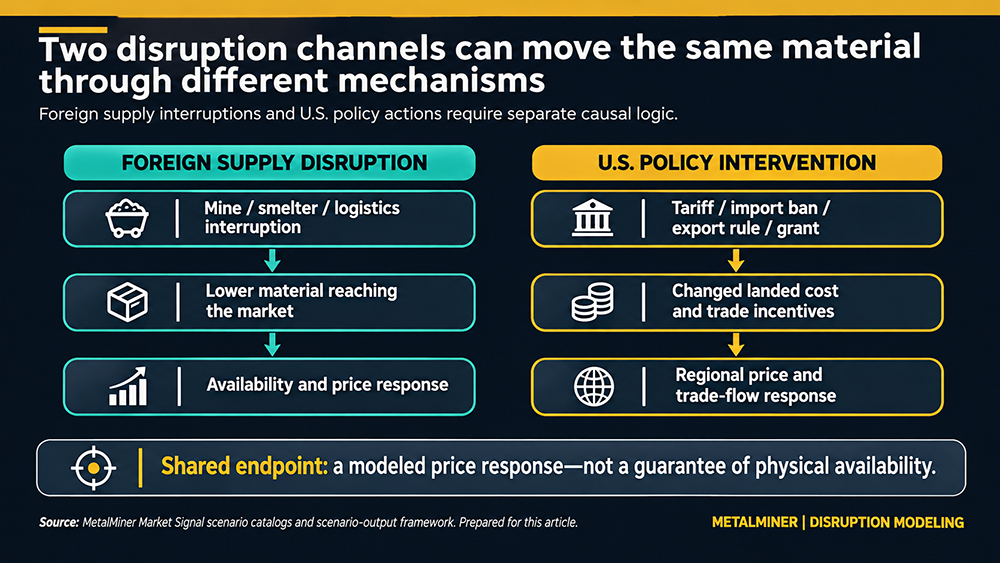
U.S. policy interventions deserve their own treatment because their impact does not depend on an overseas production loss.
The two pathways work differently:
- A disruption abroad can constrain the quantity of material reaching the market.
- A U.S. tariff or export restriction can instead change delivered economics and trade flows for companies that buy from, sell into, or compete with the U.S. market.
That distinction is especially clear in aluminum. The aluminum Midwest Premium catalog includes a market-driver scenario for a U.S. import-tariff shock, alongside policy-event options that include export restrictions, export-licensing requirements, financial grants, and selected import-tariff configurations.
The appropriate question is not simply, “Will global aluminum supply fall?” It is also, “How would a U.S. policy action change the regional cost structure facing our North American operation?” That question can matter to an overseas producer selling into the United States as much as it matters to a U.S. buyer.

Other verified catalogs carry U.S. policy events too:
- The U.S. HRC scenario catalog similarly includes a U.S. import-tariff policy event.
- The U.S. 304 2B stainless sheet catalog includes import-tariff and export-ban scenarios, with affected pools that can include the U.S. market or steel inputs.
- In critical minerals, the lithium carbonate catalog contains U.S.-jurisdiction policy-event options for import tariffs, export-licensing requirements, and financial grants.
The precise menu varies by material. Users should not assume that every policy event appears for every series.
What does a well-scoped run look like by category?
For copper, Market Signal includes a geopolitical-tension market-driver scenario, described as a supplier-country risk spike measured from historical episodes. It also includes copper ore-cost pressure, industrial-contraction, recession-signal, and policy-event scenarios.
How should a copper run be scoped?
A planner should pair that run with these company details:
- The actual copper price basis.
- Volume by plant.
- Hedge position.
- Supplier geography.
The result is a cost-risk analysis, not a conclusion about a specific country or event.
What does the steel catalog cover?
The U.S. HRC catalog centers its disruption menu on policy events, including import tariffs, import bans, and financial grants. That makes the model particularly relevant to a buyer evaluating regional price exposure and import-sensitive sourcing decisions.
It does not make the model a substitute for mill allocation analysis, lead-time monitoring, or qualification status.
What does the stainless steel catalog show about coverage limits?
The example 304 2B sheet catalog shows that scenario coverage can be narrower than the range of broader market narratives. It provides policy-event options but no published house-view or strategic scenario set in the reviewed catalog.
A disciplined user treats that as a boundary of the model, not an invitation to fill the gap with unsupported certainty.
What changes for aluminum and critical minerals?
For aluminum, separating the Midwest Premium from the underlying metal benchmark remains essential.
For Chinese lithium carbonate, the catalog combines three classes of scenario:
- Simulatable market-driver shocks, such as industrial contraction, recession signal, and dollar strengthening.
- Policy-event shocks, including export-licensing requirements.
- Longer-run strategic scenarios for supply expansion and supply restriction.
Those distinctions support better questions. They do not remove the need for material-specific supplier and logistics analysis.
What can the output support, and what can it not?
The output supports a disciplined discussion about incremental price risk under stated conditions:
- Finance teams can translate the modeled gap into a spend-at-risk range.
- Procurement teams can use it to identify where contract clauses, inventory policy, alternative supply, and sourcing timing deserve review.
- Supply chain teams can test whether a material’s cost shock coincides with a continuity exposure that requires a separate mitigation plan.
The output does not:
- Predict whether the event will happen.
- Assign a guarantee of physical availability.
- Replace a supplier’s capacity commitment, a logistics assessment, an engineering substitution review, or legal advice on an actual trade measure.
And it should not be used to state a directional metal-market call when the exercise is explicitly conditional.
How should teams govern disruption modeling?
This is why disruption modeling belongs inside a governed decision process. Within it, teams should:
- Document the chosen material basis, event definition, magnitude, duration, model confidence, decision owner, and intended use.
- Preserve the baseline and scenario output used for the decision.
- Revisit the assumptions when the contract, sourcing footprint, or policy environment changes.
The responsible conclusion is conditional. If this disruption occurs at this scale and duration, this is the modeled range of incremental price risk relative to the baseline.
That is enough to improve a budget or sourcing discussion, and it is honest about what a model can know.
To examine the available scenario coverage for a specific metal exposure, teams can explore Sage or use MetalMiner’s free “try it” access to the MetalMiner Model Context Protocol (MCP) environment. The productive first question is “Which of our exposures is material enough to stress-test, and against which event?” rather than “What will happen?”