
How to Roll Out Forecasting Tools in Your Organization Without Losing Control

Rolling out MetalMiner and its forecasting tools is not about installing a tool. It is about building a consistent operating model for how your company understands and acts on metal markets. Without that structure, different teams interpret prices differently, and decisions become fragmented.
Metal buying quickly becomes complicated across regions, business units, and product lines. One team may track exchange prices, another may rely on local mill pricing, while finance measures performance differently altogether (Read How Mills and Service Centers Take Advantage of Metal Buyers to understand this concept better, and how forecasting tools can help). That disconnect is exactly what a disciplined rollout is designed to solve.
For instance, over the last two years, the aluminum Midwest Premium rose 385.3%, COMEX copper increased 39.2%, U.S. hot-rolled coil climbed 21.8%, and LME nickel moved just 3.0%. At the same time, correlations between these metals remained weak to moderate.
In simple terms, no single benchmark explains your entire exposure.
A structured rollout creates alignment without oversimplifying how each metal behaves.
Why Does Governance Matter So Much in Metal Buying?
Because each metal behaves differently, governance ensures everyone interprets the market using the same rules.
Take, for instance, the following examples.
- The Midwest Premium (shown in the chart below) sits between support and resistance, near the upper band
- COMEX Copper trades above short-term resistance but below longer-term ceilings
- Nickel remains range-bound below resistance
- U.S. hot-rolled coil sits near the top of its 12-month range
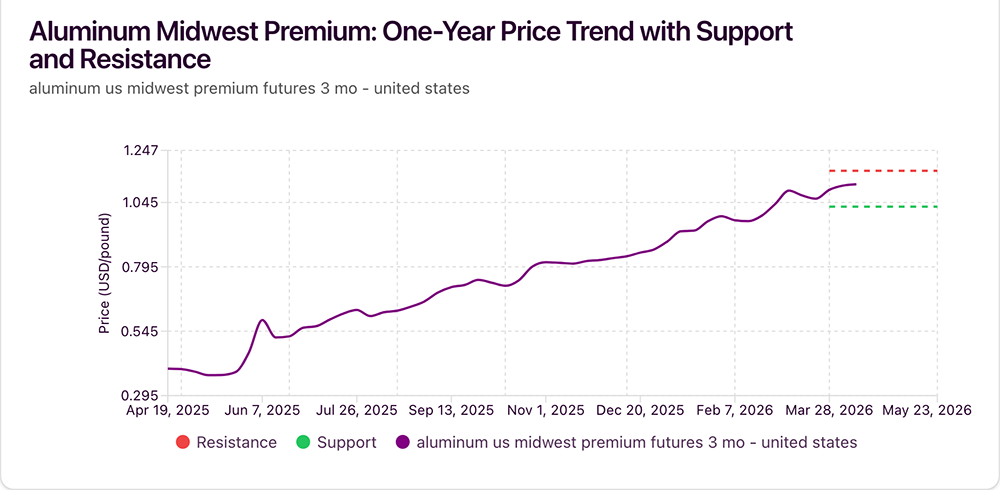
This is not predictive. It is context. And this is where tools like MetalMiner’s Sage become useful. Sage helps teams interpret these conditions consistently so decisions are grounded in shared understanding, not individual assumptions.
Without governance, teams default to their own interpretations. With it, they operate from a single source of truth.
What Is the First Step to Creating Alignment?
Start by defining one enterprise-wide benchmark taxonomy.
If your organization cannot clearly define what “copper,” “steel,” or “aluminum” price movements mean, every report becomes a debate. Different teams may use different exchanges, units, benchmarks, or pricing structures.
To fix this:
- Define one approved benchmark per material
- Standardize units, currency, and pricing structure
- Document any exceptions explicitly
With these principles in mind, you can more effectively implement the correct forecasting tools
Who Should Own the Rollout?
One accountable owner must define the rules, but execution should stay local.

A strong structure looks like this:
- Central owner: benchmark standards, KPI definitions, executive reporting
- Regional champions: local adoption, exception handling, escalation
- Category managers: sourcing decisions, supplier alignment, documentation
- Finance partner: savings validation, budget variance, compliance
This balance ensures consistency without slowing down decision-making, which How C-Suites Expect Procurement to Save Money goes into more detail about.
How Do You Drive Real Adoption Across Teams?
You build a champion network, not just a training program.
Champions translate data into action. They help teams apply insights before sourcing events, negotiations, and contract decisions.
Without champions, adoption stays theoretical. With them, it becomes habitual.
How Should You Train Different Stakeholders?
Train by role, not by feature list.
Each group needs a different level of insight:
- Executives and CFOs: exposure, variance, and policy exceptions
- Procurement leaders: governance, escalation rules, cross-region consistency
- Buyers and category managers: benchmark selection, support and resistance, supplier communication
- Analysts: chart interpretation, cross-metal relationships, reporting standards
These are not predictions. They are decision inputs.
How Do You Make Market Review a Habit?
Put it on a fixed cadence.

- Weekly: What moved?
- Monthly: Where are we exposed?
- Quarterly: Are we still aligned on definitions and KPIs?
The key question each time is simple: What did the team do with this information?
What KPIs Actually Prove Adoption?
Login counts do not matter. Behavior does.
Track:
- Benchmark coverage: Share of spend mapped to approved benchmarks
- Workflow compliance: Share of sourcing events with documented market review
- Champion activity: Training completion, issue resolution, engagement
- Finance alignment: Consistent benchmark usage across reporting
- Executive use: Review cadence and exception resolution
These KPIs show whether your organization is actually using a governed market view inside real sourcing decisions.
How Do You Measure Financial Impact?
Use outcome metrics that finance can audit.
Key examples include:
- Purchase variance versus approved benchmarks
- Savings capture versus unmanaged buying
- Percentage of contracts tied to governed benchmarks
- Time-to-decision for sourcing approvals

MetalMiner’s historical buying track record for U.S. hot rolled coil illustrates this clearly. Over two years, performance tracked 3.7% below the market benchmark cumulatively, with savings on 264 trading days. That is not forward guidance. It is a measurable way to evaluate timing performance against a transparent baseline.
Why Must Finance and Procurement Speak the Same Language?
Because misalignment slows decisions and creates unnecessary friction.
When teams use different benchmarks, units, forecasting tools, or definitions, performance becomes unclear. A strong rollout eliminates that issue by ensuring both procurement and finance rely on the same data and logic.
With access to consistent metal market transparency, teams can align faster and focus on decisions rather than reconciling numbers.
What Does a Successful Rollout Actually Look Like?
It is simple and structured:
- One benchmark taxonomy
- One accountable owner
- A strong champion network
- KPIs tied to real behavior
The goal is not to remove judgment. It is to improve it.
Buyers still decide when to act. Finance still validates results. Leadership still weighs tradeoffs. But everyone starts from the same market facts.
That is what makes a rollout with the correct forecasting tools successful. It turns metal sourcing into a consistent, teachable, and auditable operating rhythm.