
How MetalMiner Combines Human Expertise and AI to Deliver Actionable Metal Price Forecasting
A procurement platform is only useful if it reflects real procurement purchasing risks. That means steel, aluminum, copper, stainless, critical minerals, and all other types of industrial metals which require metal price forecasting.
If your team buys across any of these categories, you should not need multiple tools to understand your position. You should only need one.
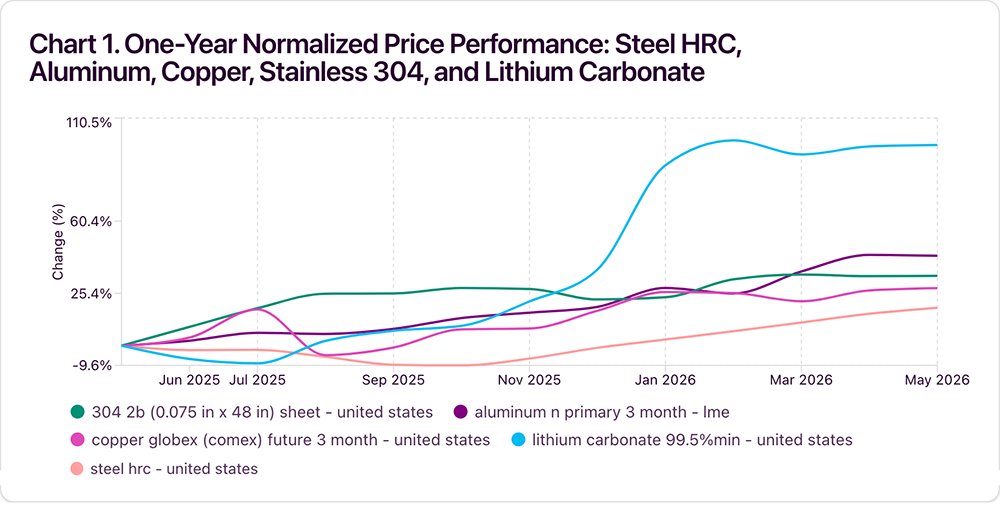
This is what MetalMiner and Sage strive to accomplish. For example, here is the latest one-year period reviewed:
- U.S. hot-rolled coil rose 16.3%
- COMEX copper rose 28.1%
- U.S. 304 stainless sheet rose 35.8%
- LME aluminum rose 47.3%
- U.S. lithium carbonate rose 75.4%
What this means for buyers:
You are rarely exposed to only one purchasing risk. A forecasting platform should accurately reflect that reality, so you can evaluate your total cost pressure.
Does the Platform Reflect How You Actually Buy Metals?
Global benchmarks matter, but procurement decisions are made against:
- Mill offers (read more in How Mills and Service Centers Take Advantage of Metal Buyers)
- Contract formulas
- Domestic supply conditions
- Geopolitical risks
MetalMiner allows users to view both global and domestic series in one place with Market Signal, which mirrors how real buying decisions happen.
Takeaway:
If a platform cannot bridge global and local pricing, it will not help you negotiate effectively or provide more accurate metal price forecasts.
Are Product Details, Units, and Currency Clear?
Vague market intelligence leads to bad purchasing decisions.
Buyers need clarity on:
- Product forms (plate, coil, bars, tubes, sheet, etc.)
- Units (short tons, pounds, metric tons)
- Currency (USD, EUR)

MetalMiner maintains this detail consistently. Without precision, internal reporting breaks down, and supplier comparisons become unreliable.
Does Your Metal Price Forecasting Provide Enough Historical Context?
A spot price tells you where market prices currently sit. It does not tell you if that level is high, low, or normal.
MetalMiner provides deep historical coverage and data going back 10-years +. Historical data sets are critical for creating accurate forecasts, and this is what AI models typically lack and why LLMs alone are unreliable.
Essentially, history is what turns price data into decision-making insight.
Can You See Where the Market Sits Within Its Range?
Knowing the current price is not enough. You need more market context. For example:
- Support levels
- Resistance levels
- Relative positioning
Example:
- HRC at $1,055 per short ton
- Support near $1,015
- Resistance near $1,092

What this means for sourcing:
When the price moves outside of support and resistance levels, buying organizations can take action. Its movement outside the ranges that trigger a change in buying behavior.
Is That Same Level of Insight Available Across All Metals?
Consistency matters.
Examples:
- Copper: $5.9845/lb with defined support and resistance
- Aluminum: $3,523/mt within a clear range
- Stainless: $1.6206/lb with technical boundaries

Can You Test Market Relationships Instead of Relying on Assumptions?
Common assumptions often guide decisions. Some common ones:
- Stainless follows nickel
- Copper and aluminum move together
But assumptions need validation to be true, otherwise they’re just assumptions.
Does It Connect Data to Real Decision Outcomes?
A platform should show historical performance, not just analytics.
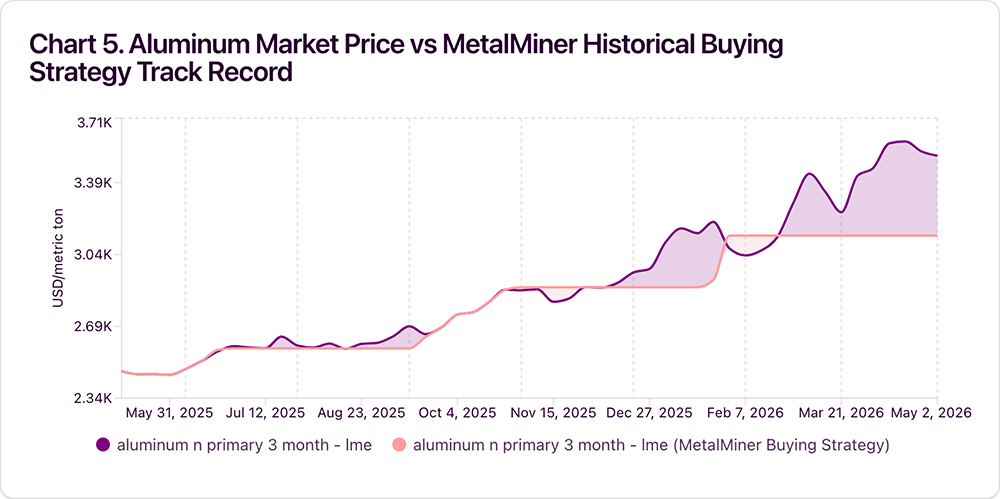
MetalMiner’s aluminum track record:
- 2.72% cumulative savings vs. market
- Savings on 197 of 364 days
- Max savings: 13.82%
- Max loss: -3.41%
Why this matters:
Transparency builds trust. Historical performance shows whether insights actually translate into results.
Is It Usable Across the Entire Organization?
A platform should not create more work, it should make existing work easier and less time-consuming.
It should support:
- Procurement
- Finance
- Operations
MetalMiner allows users to move between:
- Raw price views
- Normalized comparisons
- Technical charts
- Strategy analysis
Takeaway:
If your team has to rebuild everything in spreadsheets, the platform is not doing its job.
What This Means for Your Sourcing Strategy
A strong platform should help you:
- Evaluate whether current prices are fair or overpriced
- Understand where markets currently sit
- Identify timing opportunities
- Validate supplier quotes
- Reduce decision-making risks
The Bottom Line
A metal price platform should not just provide data. It should help you use that data.
The key questions remain:
- Does it cover the metals that matter to my company?
- Does it reflect real buying conditions?
- Does it provide the necessary market context and pricing history?
- Can it support better purchasing decisions?
By that standard, MetalMiner holds up well. It connects price data, technical context, and historical analysis into something procurement teams can actually act on.
And ultimately, that is the difference between watching the market and managing it.