
Cobalt may be a minor constituent of lithium ion batteries, but it is a crucial one. Need buying strategies for steel? Try two free months of MetalMiner’s Outlook Lithium has been the metal in the news this year. Bolstered by rising demand for hybrid and electric cars, however, the supply market has been struggling to […]
Search Results for: steel
Stainless MMI: LME Nickel Prices Drop While Stainless Surcharges Rise
The Stainless Steel MMI (Monthly Metals Index) traded flat in March after a big jump in February. The current reading is 75 points.
Need buying strategies for steel? Try two free months of MetalMiner’s Outlook

The index remained flat as LME nickel prices decreased slightly, while other elements of the stainless steel basket increased. Stainless steel surcharges jumped again this month, largely following the previous month’s LME nickel price movements.
LME Nickel
Nickel momentum appears to have slowed since the beginning of March. Prices retraced slightly. However, nickel prices remain in a strong, long-term uptrend.
[caption id="attachment_90804" align="aligncenter" width="580"] Source: MetalMiner analysis of FastMarkets[/caption]
Like copper prices, nickel prices remain above the blue dotted line above. In December, nickel prices rallied and started to trade with a sharper slope, following the purple dotted line.
However, these movements are often not sustainable in the long-term trend, and commonly correct. Therefore, nickel prices retraced to their long-term trendline, while trading volume remains supportive of the uptrend.
Domestic Stainless Steel Market
Following the recovery in stainless steel momentum, domestic stainless steel surcharges increased further this month.
The 316/316L-coil NAS surcharge breached its previous $0.8/pound ceiling. Stainless steel surcharges increased again rapidly. Therefore, buying organizations will want to look at surcharges to identify opportunities to reduce price risk either via forward buys or hedging.
[caption id="attachment_90805" align="aligncenter" width="580"] Source: MetalMiner data from MetalMiner IndX(™)[/caption]
Tariffs Do Not End in the U.S.
The European Commision prolonged the already existing anti-dumping measures on Chinese imports of stainless steel seamless pipes and tubes for another five years. The duties imposed initially in 2011 ranged from 48.3% to 71.9%. These duties gave European stainless steel producers — like France, Spain and Sweden — some breathing room.
The review of these measures started again in December 2016 and showed the removal of duties on Chinese products would harm European producers.
Therefore, the European Commission agreed to maintain the current duties on pipes and tubes used in the chemical and petrochemical industries for another five years.
Although the Europeans have not enacted broad tariffs like the U.S. has done via Section 232 of the Trade Expansion Act of 1962, the issue of global overcapacity remains paramount as the E.U. continues to implement heavy duties on stainless steel products to limit imports.
What This Means for Industrial Buyers
Stainless steel momentum appears stronger this month, recovering from its previous weakness.
As both steel and nickel remain in a bull market, buying organizations may want to follow the market closely for opportunities to buy on the dips.
To understand how to adapt buying strategies to your specific needs on a monthly basis, take a free trial of our Monthly Outlook now.
Buying organizations who have concerns about the Section 232 impact on the steel industry may want to read our comprehensive Section 232 Report, which includes new data.
MetalMiner’s Annual Outlook provides 2018 buying strategies for carbon steel
Actual Stainless Steel Prices and Trends
This Morning in Metals: Australia Won’t Join E.U. in Tariff Complaints to WTO
This morning in metals news, Australia doesn’t plan on joining the E.U. in any prospective complaints to the World Trade Organization (WTO) over U.S. tariffs, Chilean miner Codelco signs a deal for a plant in Ecuador and workers at a Peruvian zinc smelter ended their strike over the weekend. Need buying strategies for steel? Try […]
GOES MMI: M3 Prices Rise with Section 232 Support
The impact of the president’s Section 232 proclamation applying a 25% import duty on all steel articles with HTS codes 7206.10 through 7216.50, will have a somewhat predictable impact on steel prices (they will increase, at least in the short term).
Need buying strategies for steel? Try two free months of MetalMiner’s Outlook

The impact on grain-oriented electrical steel (GOES) buying organizations, MetalMiner believes, will not exactly mirror the broader impact of the tariffs on commonly purchased steel forms, alloys and grades.
But first, the reaction to the announcement of the steel tariffs from Roger Newport, the CEO of AK Steel, and the last remaining GOES producer in the U.S.: “We support President Trump for taking the bold action of imposing a 25% global tariff on steel to defend America’s steel industry and its workers from imports that threaten our national and economic security,” he said. “Nowhere is this threat more evident than in electrical steel where AK Steel is now the only domestic producer of electrical steel for electrical transformers. Years of surging imports and the subsequent market volatility caused the only other U.S. producer to exit the market in 2016. This action by the President could not come soon enough as the surge of electrical steel imports continued throughout last year, with imports nearly doubling in 2017 when compared to 2016.”
GOES Markets Are More Nuanced Than Other Flat Rolled Products Markets
GOES markets serve as an example of where and how certain sub-segments of the steel industry will attempt to carve out exceptions and/or exemptions from the tariff proclamation — specifically, under point 11 of Trump’s proclamation.
MetalMiner believes that Japanese producers, along with their importing partners and customers, will petition the Department of Commerce for an exception by proving that certain highly engineered grades of electrical steel are not in fact produced in the United States.
The president’s proclamation identifies the procedure by which exceptions can be made:
The Secretary, in consultation with the Secretary of State, the Secretary of the Treasury, the Secretary of Defense, the United States Trade Representative (USTR), the Assistant to the President for National Security Affairs, the Assistant to the President for Economic Policy, and such other senior Executive Branch officials as the Secretary deems appropriate, is hereby authorized to provide relief from the additional duties set forth in clause 2 of this proclamation for any steel article determined not to be produced in the United States in a sufficient and reasonably available amount or of a satisfactory quality and is also authorized to provide such relief based upon specific national security considerations. Such relief shall be provided for a steel article only after a request for exclusion is made by a directly affected party located in the United States.
Clearly, the impact of imports on the domestic GOES market has come on the back of rising and significant Japanese imports. China and South Korea are non-players for GOES into the U.S.
[caption id="attachment_90783" align="aligncenter" width="580"] Source: International Trade Administration and MetalMiner Analysis[/caption]
The real question involves whether or not customers of Japanese products will be able to prove that the materials they are buying from Japan, are indeed not produced in the U.S.
The president has mandated that the secretary of commerce issue procedures for requests for tariff exclusions within 10 days of the proclamation date (which was March 8).
MetalMiner’s Annual Outlook provides 2018 buying strategies for carbon steel
Exact GOES Coil Price This Month
Week in Review: Tariffs, Tariffs and More Tariffs Dominate the Week’s Headlines
Before we head into the weekend, let’s take a look back at the week that was and some of the headlining stories here on MetalMiner: Need buying strategies for steel? Try two free months of MetalMiner’s Outlook How did the rest of the world react to President Donald Trump’s initial announcement last week about steel […]
Linking Section 232 Action to NAFTA May Backfire
Is it just me or is there a contradiction developing at the heart of President Trump’s linkage of movement on the North American Free Trade Agreement (NAFTA) negotiations to the application of steel and aluminum tariffs on imports from Canada and Mexico? I have been pondering this since earlier this week when the topic was […]
Rare Earths MMI: Toyota Develops Neodymium-Reduced Magnet
The Rare Earths MMI (Monthly Metals Index) held steady, notching a reading of 20 for our March MMI.
Need buying strategies for steel? Try two free months of MetalMiner’s Outlook

Within the basket of metals, Chinese yttrium dropped slightly, while terbium metal picked up in price.
Europium oxide also dropped slightly, while dysprosium oxide picked up an extra dollar per kilogram.
New Toyota Magnet Not Dependent on Some Rare-Earth Minerals
According to a report by Ars Technica, a new magnet developed by automaker Toyota will not be dependent on some key rare-earth minerals.
Toyota announced it had invented a magnet — for application in electric vehicles — that uses much less of the rare-earth mineral neodymium. According to Toyota, it had developed “the world’s first neodymium-reduced, heat-resistant magnet.”
Of course, cost is a major restraining factor when it comes to electric vehicle (EV) growth. Materials needed for EV batteries, like neodymium, are costly, and many battery makers have sought to reconfigure the percentages of metals used in their batteries to phase out more cost-prohibitive materials (like cobalt, for example).
In addition to reducing the use of neodymium, the new magnet also completely phases out two other rare earth minerals.
“The newly developed magnet uses no terbium (Tb) or dysprosium (Dy), which are rare earths that are also categorized as critical materials necessary for highly heat-resistant neodymium magnets,” according to the Toyota statement. “A portion of the neodymium has been replaced with lanthanum (La) and cerium (Ce), which are low-cost rare earths, reducing the amount of neodymium used in the magnet.”
According to the announcement, the new magnet reduces the amount of neodymium used by as much as 50%.
Europium Market to Hit $308.9M by 2025
The global europium market is set to hit a value of $308.9 million by 2025, according to a recent report by Reportbuyer.
According to the report, consumer electronics, automotive, semiconductors, and energy and mining are the sectors leading the charge in the growth of europium.
Want to see an Aluminum Price forecast? Take a free trial!
Actual Metal Prices and Trends
How Will Trump’s Proposed Tariffs Impact India?
The Indian metal industry seems divided for now over the implications of U.S. President Donald Trump’s announcement of the intention to impose tariffs on steel and aluminum imports. Need buying strategies for steel? Try two free months of MetalMiner’s Outlook News reports and statements by industry leaders, along with reports by research agencies, show no […]
Construction MMI: Spending Flattens as Industry Awaits Tariffs Decision
The Construction MMI (Monthly Metals Index) dropped one point this month, falling to 93 for our March reading.
Need buying strategies for steel? Try two free months of MetalMiner’s Outlook
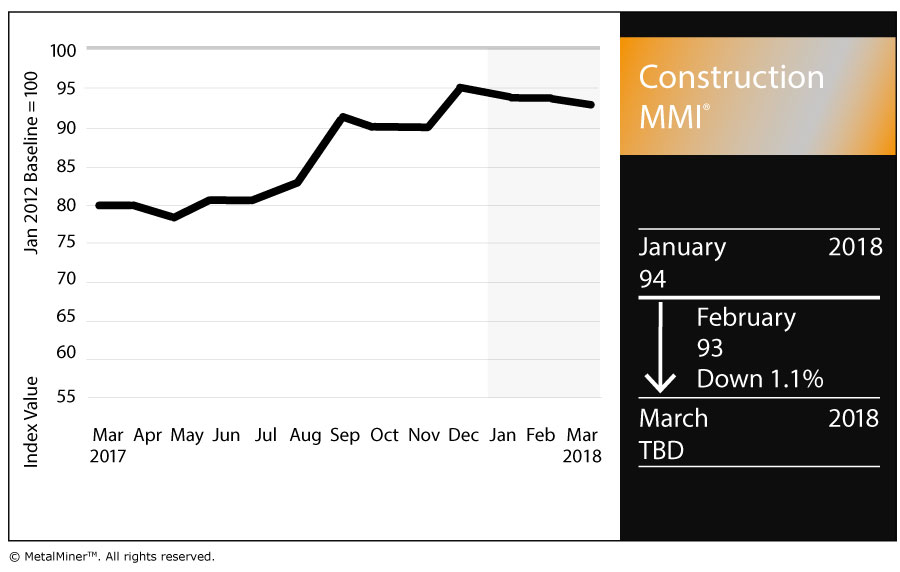
Within the basket of metals for the Construction MMI, Chinese rebar and H-beam steel prices dropped on the month. Meanwhile, U.S. shredded scrap steel rose 8.4% on the month, while European commercial 1050 sheet fell 3.0%.
Chinese aluminum bar also fell, dropping 1.0% month over month.
U.S. Construction Spending
According to U.S. Census Bureau data for January, total spending stood pat from December, but was up year over year.
Construction spending during January 2018 was estimated at a seasonally adjusted annual rate of $1,262.8 billion, up minimally from the revised December estimate of $1,262.7 billion, according to the Census Bureau.
The January figure, however, was up 3.2% from January 2017’s $1,223.5 billion.
Construction spending during January 2018 was estimated at a seasonally adjusted annual rate of $1,262.8 billion, up minimally from the revised December estimate of $1,262.7 billion, according to the Census Bureau.
The January figure, however, was up 3.2% from January 2017’s $1,223.5 billion.
Meanwhile, spending on private construction was at a seasonally adjusted annual rate of $962.7 billion, 0.5% above the revised December estimate of $967.9 billion.
Under the umbrella of private construction, residential construction was at a seasonally adjusted annual rate of $523.2 billion in January, 0.3% above the revised December estimate of $521.8 billion. Nonresidential construction was at a seasonally adjusted annual rate of $439.6 billion in January, 1.5% below the revised December estimate of $446.2 billion.
As for public construction, the estimated seasonally adjusted annual rate of public construction spending was $300.1 billion, 1.8% above the revised December estimate of $294.8 billion.
Within that, educational construction was at a seasonally adjusted annual rate of $76.7 billion, 2.1% above the revised December estimate of $75.2 billion. Highway construction was at a seasonally adjusted annual rate of $92.6 billion, 4.4% above the revised December estimate of $88.8 billion.
Construction and Tariffs
Just like other metal-using sectors, the construction industry would also be impacted by President Trump’s announced steel and aluminum tariffs (especially steel).
Trump’s announcement came just over a month after Trump proposed $1.4 trillion in infrastructure investment over 10 years.
For a construction industry that saw spending flatten in January, a rise in materials costs would not be great news, should the tariffs become the law of the land.
According to Philip Gibbs, an analyst at KeyBanc Capital, the tariffs might give steel stocks a short-term “sugar high,” he told Reuters, but that unsustainable pricing could eat into demand from manufacturers.
The National Association of Homebuilders (NAHB) came out against the tariffs proposal, with the association’s chairman saying the tariffs would hurt consumers and make housing less affordable.
“It is unfortunate that President Trump has decided to impose tariffs of 25 percent on steel imports and 10 percent on aluminum imports,” said Randy Noel, chairman of the NAHB. “These tariffs will translate into higher costs for consumers and U.S. businesses that use these products, including home builders.
“Given that home builders are already grappling with 20 percent tariffs on Canadian softwood lumber and that the price of lumber and other key building materials are near record highs, this announcement by the president could not have come at a worse time.”
Of course, the metals world is still in wait-and-see mode regarding the tariffs, which have yet to become actual law.
MetalMiner’s Annual Outlook provides 2018 buying strategies for carbon steel
Actual Metal Prices and Trends
Copper MMI: Prices Retrace as U.S. Dollar Firms
The Copper MMI (Monthly Metals Index) traded lower this month, falling two points to 87 for our March reading.
The Copper MMI fell for the second consecutive month, after the sharp increase in prices at the end of last year. In February, LME copper prices fell by 3.5%.
Need buying strategies for steel in 2018? MetalMiner’s Annual Outlook has what you need
The LME copper short-term downtrend does not seem that bearish when looking at the two-year chart. Copper prices retraced this month again, but still hold above the blue dotted line, which represents the trend line (prices below that line might indicate a change in trend). In December, copper prices skyrocketed and breached the $7,000/st level, confirming long-term bullish sentiment remains intact.
[caption id="attachment_90695" align="aligncenter" width="580"] Source: MetalMiner analysis of FastMarkets[/caption]
Meanwhile, this month, a stronger U.S. dollar added downward pressure to commodities and industrial metals. Analysts also claim the latest “bearish” downtrend occurred due to increasing LME stocks.
MetalMiner analyzes copper supply from two different perspectives: copper stocks and global copper supply.
Copper Stocks
Copper stocks at the major metal exchanges totaled 537,722 tons at the end of November 2017, reflecting a decrease of 0.3% from stocks in December 2016. In particular, LME stocks fell by 41%, while SHFE stocks increased by 12% in 2017.
However, 2018 has come with some recoveries for LME copper stocks.
Copper stocks are at a current 324,900 tons. This means LME copper stocks are 13,075 tons higher than at the beginning of 2017, and 85,500 tons higher than at the beginning of 2016.These numbers show some recovery for LME copper stocks; this information has likely fueled trading sentiment this month.
CME stocks also increased at the beginning of the year. In 2015, CME stocks were just at 20,000 tons, compared to the current 209,000-ton level. Both of these numbers (CME and LME stock levels) have moved trader sentiment.
Global Copper Supply
The Indonesian unit of Freeport-McMoran’s copper mine and Amman Mineral Nusa Tenggara (AMNT) are waiting for last-minute ministry approvals to their application for an extension to continue with copper concentrate exports. Freeport’s export order for the Grasberg mine expires this month (copper mines have to reapply for export licenses every year).
Freeport had an export quota of 1.1 million tons of copper ore concentrate ending February 2018. Exports could stop this month, but mine production could continue.
Meanwhile, the Chinese Ministry of Environmental Protection has tightened the “allowable” impurities levels further. Therefore, instead of importing scrap, China now imports unwrought copper for downstream production.
Copper supply also looks threatened in Chile and Peru, particularly if workers go on strike since labor contracts expire soon. The powerful labor union at the Escondida copper mine cast doubt on the chances of starting talks on a new labor agreement with the company before formal negotiations commence in June.
Global copper supply still shows some uncertainty with possible copper supply shortages coming in 2018. Therefore, buying organizations may want to understand the global picture rather than just considering the trend based on stock levels and actual copper supply.
What This Means for Industrial Buyers
In February, buying organizations had some opportunities to buy some volume. As long as copper prices remain bullish, buying organizations may want to buy on the dips. For those who want to understand how to reduce risks, take a free trial now to the MetalMiner Monthly Outlook.
MetalMiner’s Annual Outlook provides 2018 buying strategies for carbon steel
Actual Copper Prices and Trends